Financial Management (FIN 3200 | Weber State)
Chapter 1
- Objective: Maximize shareholder wealth by maximizing fundamental value of stock price
- Money market securities: Mature in less than a year
- Capital Market Securities: Mature in more than a year or not at all
- Four fundamental factors that affect the cost of money
- Production opportunities
- Time preference for consumption
- Risk
- Inflation
Direct: Giving cash for a claim on risky future cash
- Primary market transaction
Investment Bank: underwriter serves as a middleman - Primary market transaction
Financial Intermediary: Savers pay intermediary in exchange for securities of the intermediary.
Financial Instrument: Any claim on future cash flows
Financial Security: A claim that is standardized and regulated
Proprietor
Partner
Corporation
Chapter 2
Indifference Tax Rate
Net Cash Flows
EBIT
(Interest)
(Tax)
NI
+Depreciation
NCF
Free Cash Flows
| NOPAT | |
|---|---|
| NOWC = |
|
| - NIOC | |
| = Free Cash Flow |
ROIC
EVA
Chapter 3
Return: Net Income on Top
Turnover: Sales on Top (Except IT)
Liquidity Ratios
Leverage Ratios
- Exception to turnover rule
Debt Ratios
Profitability Ratios
Market Value Ratios
DuPont
- PM = Return on Sales
- EM = TA/TE (Emory Tate)
- TAT = Sales/TA
Chapter 4
Make a timeline
TVM
N: Number of periods
I/YR: Interest money now would incur per period
PV: Current Value of future cash
PMT: Annuity
FV: Future Value
- Ordinary (end mode) | Annuity due (begin mode)
Uneven Cash Flows
Enter Discount Rate
Enter Cash Flows
Find NPV
Net Future Value
- SWAP from NPV
EFF%
Enter Nominal as I/YR
Enter # of compounding periods as P/YR
Solve EFF%
Amortization
Beg Period, INPUT, End Period, Red, FV (AMORT) - Y
- Principal PMT:
- Interest PMT:
- Remaining Loan Balance:
Make sure N and I/YR are adjusted
Chapter 5
Bond Valuation
- N: Time to maturity
- r: Rate on debt (
), Yield to maturity (YTM), Market, Yield to call (YTC) - PV: (Price)
- PMT: par
Coupon rate - FV: par
1 payment per year, end mode
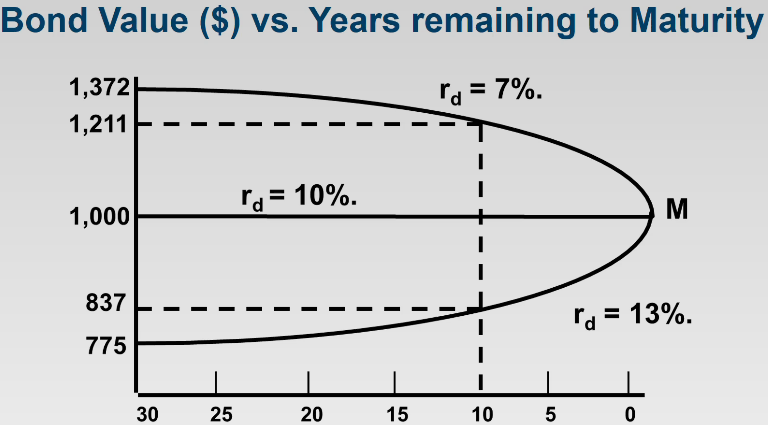
Bond Yield
Bond Rates
- MRP = Default risk + Liquidity Premium
- MRP only on corporate bonds
- For IP use Average IP though the time period
Bond Price
Use TVM
N
r
Price
Par x Coupon
Par
Adjust for semi annual (N x 2, r/2, PMT/2
Call
Call Period
r
Price
Par x Coupon
Call Price
Expect on premium bonds
Chapter 6
Regression
Enter Values
- x, =, y,
- Mean (Shift 7)
- Stdev (Shift 8)
- Population Stdev (Shift 9)
- Alpha (Shift, 6, SWAP) - b
- Beta (Shift, 5, SWAP) - m
- Correlation (Shift, 4, SWAP) - r
- Goodness of fit =
- Future Estimate (enter X value, orange, 5)
Statistics
Portfolio Analysis
CAPM
Chapter 7
Constant Growth Model
Preferred Stock
Multistage Valuation Model
Cash Flow (HP10bII+)
- Enter
as i/YR - Calculate NPV (Orange, PRC)
Cross out start and finish, used only for calculations
Chapter 9
Component Cost of Debt (
Component Cost of Preferred Stock (
Component Cost of Common Equity (
or- OBY + JRP
Discounted Cash Flows (RE and NS)
Retained Earnings:
New Stock:
Weighted Average Cost of Capital (WACC)
Identify: Target Capital Structure
- Debt
- Preferred Stock
- Equity (Retained earnings or New Stock)
Breakpoint
- Largest capital budget without issuing new stock
Chapter 10
Discount with WACC
Payback
Investment
(Cash Flow)
Repeat
Discounted Payback
Investment
(Discounted Cash Flow)
Repeat
TVM for DCF
- N
- WACC
-
- 0
- Cash Flow
Net Present Value
Enter Cash Flows
Enter WACC as I/YR
Solve NPV
Equivalent Annual Annuity
TVM
- # of periods
- WACC
- NPV
- EAA
- 0
Profitability Index
Internal Rate of Return
Enter Cash Flows
Solve for IRR
Modified Internal Rate of Return
Terminal Value = NFV of future cash inflows
- Enter future cash inflows (no outflows)
- Enter I/YR
- Solve NFV (NPV, SWAP)
TVM - # of periods
- MIRR
- Investment
- 0
- TV
Crossover Rate
Enter Cash flow differences as cash flows
Solve for IRR%
Solve for NPV using IRR as Discount rate to check (should be the same for both)
Chapter 14
Irrelevant: Doesn't matter (can sell or buy for liquidity preference)
Bird in the hand: Dividends are more valuable
Tax Effect: Higher capital gains so taxes are deferred
Clientele Effect: Past policy has determined who bought in the past
Signaling: Increased dividends signal higher expected EPS
Residual distribution Model
-
-
-
Equity Ratio + Debt Ratio = 100%
Repurchase
Calculate Market Cap
($ Repurchase)
/ Market Price
# Shares Remaining
Chapter 16
Set up Relaxed, Moderate, and Tight Policies
Assets
Interest Expense (per policy)
Sales x Policy% = Current Assets
+ NFA = TA
x %Debt = Debt Level
x
Income Statement
Identify EBIT
(Interest)
x (1-TR)
Net Income
Cash Conversion Cycle
- PD = Time from purchase to Cash Outflow
Liabilities
Enter as I/YR
Enter 365 / Costly Time Period as P/YR
Solve for EFF%
or
(D%/1-D%)
+1
^(365/Costly Time Period)
-1
= EFF%