CLEP Microeconomics
Table of Contents
- [[#1. Basic Economic Concepts (10-16% of exam)]]
- [[#2. 2. Supply and Demand (15-20% of exam)]]
- [[#3. Theory of Consumer Choice (5-10% of exam)]]
- [[#4. Production and Costs (10-15% of exam)]]
- [[#5. Firm Behavior and Market Structure (25-33% of exam)]]
- [[#6. Factor Markets (6-12% of exam)]]
- [[#7. Market Failure and Role of Government (8-14% of exam)]]
- [[#Formulas]]
- [[#Exam]]
1. Basic Economic Concepts (10-16% of exam)
The study of how people allocate scarce resources
Production Possibilities Curve (PPC)
- Shows maximum output combinations with given resources in a snapshot of time
- Points on curve = efficient; inside = inefficient; outside = impossible
Comparative Advantage and Trade
- Law of Comparative Advantage: Difference in relative costs of production are key to determining patterns of trade
- Comparative Advantage: Lower opportunity cost in production
- cannot have comparative advantage for both goods
- Absolute Advantage: Higher productivity/efficiency
- Specialization and trade leads to higher consumption for both parties
- Self Sufficiency: Producing everything for yourself
Economic Systems
Systems of production, allocation, exchange, and distribution
- Market Economy: Private ownership and allocation (capitalism)
- Property Rights: Essential for market economies, ability to own (use, earn, transfer and enforce rights)
- Command Economy: Government ownership and allocation (communism)
- Market Socialism: Planned ownership, Private allocation
- Property Rights: Legal framework for ownership and resource allocation
Marginal Analysis
Costs and benefits of one additional unit
- Profit Maximization:
- Produce where Marginal Revenue = Marginal Cost
- Vise versa for factors of production (labor)
- Consumer Maximization:
2. Supply and Demand (15-20% of exam)
Market Equilibrium
- Equilibrium: Where supply and demand curves intersect (
, ) - The invisible hand will pull toward this equilibrium
- Surplus: Price above equilibrium; quantity supplied > quantity demanded (floor)
- Shortage: Price below equilibrium; quantity demanded > quantity supplied (ceiling)
- Perfect Competition: we assume perfect competition - many buyers and sellers, identical goods, no barrier to entry or exit, perfect access to information, no externalities, no single agent is able to exert price control.
- firms are price takers
Demand
- Comes from Buyer
- Shifters: Income, Preference, Related goods, Number of buyers, Future expectations
- movement caused by change in price. Usually from changing supply
- Negative slope: consumers buy when MU = MC, decreasing marginal utility and variable consumer utility leads to a negative Demand Slope (Schedule).
- Compliments: consumed together. (negative cross price relationship)
- Substitutes: consumed instead. (positive cross price relationship)
- Normal Good: Increased demand when income rises
- Inferior Good: Decreased demand when income rises
Supply
- Comes from Seller
- Shifters: Production costs, Technology, Number of sellers, Government regulation, Future expectations
- movement caused by change in price. Usually from changing demand
- Positive slope: producers supply where MR = MC. they supply more when they can charge more (greater marginal revenue)
Price Controls
Government set limits
- Binding: Interfere with equilibrium
- Price Ceiling: Maximum legal price. (Rent control)
- Creates a shortage because
is higher at the lower price, and is lower
- Creates a shortage because
- Price Floor: Minimum legal price. (Agriculture Support)
- Creates a surplus because
is higher at the higher price, and is lower
- Creates a surplus because
- Binding: Controls that affect equilibrium
Elasticity
How much does quantity respond to price change
- Price Elasticity:
- Percent Method:
/ - Midpoint Method:
/
- Percent Method:
- Elastic: |Ed| > 1 (responsive to price changes)
- Inelastic: |Ed| < 1 (less responsive to price changes)
- Income Elasticity: Distinguishes normal from inferior goods (replace price with Income)
- Positive = Normal good. Negative = Inferior good
- Cross-Price Elasticity (
): Determines substitutes vs. complements - Positive = Substitute. Negative = Compliment. |
| > 1 (strong correlation)
- Positive = Substitute. Negative = Compliment. |
- Elasticity is not determined by the graph, but by where on the graph you are
Welfare Economics
- Consumer Surplus:
. Area below demand curve, above price - Producer Surplus:
. Area above supply curve, below price - Total Surplus:
- Equilibrium maximizes total surplus (allocative efficiency)
Taxation
- Creates wedge between price paid by buyers and received by sellers
- Tax Burden: Split based on relative elasticities. More elasticity = greater burden
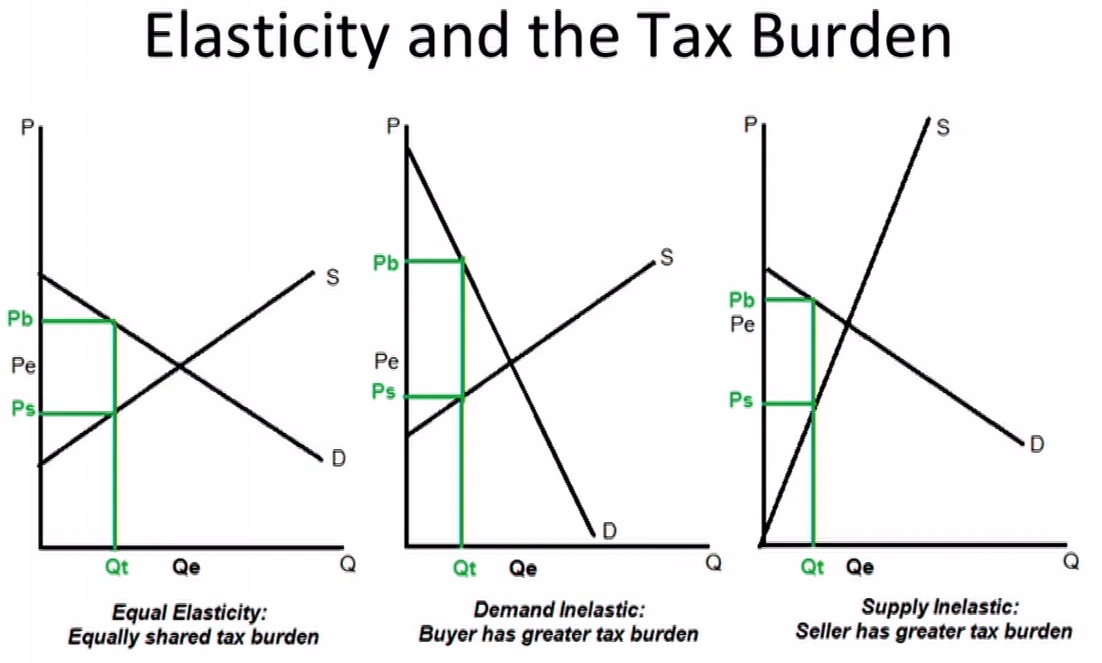
- Deadweight Loss: Efficiency loss from taxation
- Tax Revenue = Tax × Quantity (after tax)
3. Theory of Consumer Choice (5-10% of exam)
Utility Theory
- Total Utility: Total satisfaction from a given quantity (Parabolic)
- Total utility maximized when
(x-intercept)
- Total utility maximized when
- Marginal Utility: Additional satisfaction from one more unit (Usually linear in examples)
- Diminishing Marginal Utility: MU decreases as consumption increases, even into negatives
Consumer Optimization
- Budget Constraint Curve: Shows all affordable consumption combinations
- Equimarginal principle (Utility Maximization Rule):
- Consumer equilibrium: where budget is fully spent and the equimarginal principle is met
- The Consumer Demand Curve: comes from the optimal bundle at each price
- Market Demand Curve: the sum of all consumer demand curves
(Continue From Here) Income and Substitution Effects
- Income Effect: Change in consumption due to change in purchasing power
- Substitution Effect: Change in consumption due to relative price changes
- Both effects work together when prices change
- Help explain downward-sloping demand curves
4. Production and Costs (10-15% of exam)
Production Functions
- Short Run: At least one fixed input (usually capital)
- Long Run: All inputs variable
- Total Product: Maximum output from given inputs
- Marginal Product: Additional output from one more input unit
- Diminishing Returns: MP eventually decreases as input increases
Cost Concepts
- Fixed Costs (FC): Costs that don't change with output
- Variable Costs (VC): Costs that change with output
- Total Cost (TC): FC + VC
- Marginal Cost (MC): ΔTC/ΔQ
- Average Costs: AFC = FC/Q, AVC = VC/Q + ATC = TC/Q
Cost Curve Relationships
- MC intersects AVC and ATC at their minimum points
- When MC < ATC, ATC is falling
- When MC > ATC, ATC is rising
- AFC always decreases as output increases
Long-Run Costs
- Economies of Scale: ATC decreases as output increases
- Constant Returns to Scale: ATC remains constant
- Diseconomies of Scale: ATC increases as output increases
5. Firm Behavior and Market Structure (25-33% of exam)
Profit Maximization
- Economic Profit: Total Revenue - Total Economic Costs
- Accounting vs. Economic Profit: Economic includes opportunity costs
- Profit Maximization Rule: Produce where
- Shutdown Rule: Continue if
(short run)
Perfect Competition
Characteristics:
- Many buyers and sellers
- Identical products
- Free entry and exit
- Perfect information
Behavior:
- Firms are price takers (P = MR)
- Short run: Can earn profits or losses
- Will incur losses if
- Will incur losses if
- Long run: Zero economic profit
- Allocatively efficient when
Monopoly
Characteristics:
- Single seller
- Barriers to entry
- Price setter
Behavior:
- Profit maximization: MR = MC, charge price from demand curve
- P > MC (allocatively inefficient)
- Creates deadweight loss
- Can earn long-run economic profits
Sources of Monopoly Power:
- Resource ownership
- Government-created monopolies
- Natural monopolies
Oligopoly
Characteristics:
- Few sellers
- Interdependent decision making
- Barriers to entry
Game Theory:
- Nash Equilibrium: Each player's strategy is optimal given others' strategies
- Dominant Strategy: Best choice regardless of what others do
- Tension between cooperation and self-interest
- Oligopolies will tend toward market equilibrium
Monopolistic Competition
Characteristics:
- Many sellers
- Differentiated products
- Free entry and exit
Behavior:
- Short run: Like monopoly (can earn profits)
- Long run: Like perfect competition (zero economic profit)
- producing where MR=MC, price will eventually = ATC, due to firms entering and exiting
- reduced market share can be viewed as a decrease in supply
- P > MC (some inefficiency)
- Excess capacity in long run
6. Factor Markets (6-12% of exam)
Derived Demand
- Input demand derives from output demand
- Marginal Revenue Product (MRP): MR × MP
- Value of Marginal Product (VMP): P × MP (in perfect competition)
- Firm hires inputs where MRP = input price
Labor Markets
- Labor Demand: Determined by MRP of labor
- Labor Supply: Determined by opportunity cost of time
- Equilibrium Wage: Where labor supply = labor demand
- Marginal Factor Cost (MFC): Cost of hiring one more worker
Factors Affecting Factor Demand
- Output price changes
- Productivity changes
- Prices of other inputs
- Technology changes
7. Market Failure and Role of Government (8-14% of exam)
Externalities
- Positive Externalities: Benefits to third parties (education, R&D)
- Negative Externalities: Costs to third parties (pollution)
- Private Value vs. Social Value: Market failures occur when they differ
- Solutions: Taxes, subsidies, regulations, property rights
- Market Efficiency: (allocative efficiency) occurs when resources are allocated to their highest-valued uses, maximizing total social welfare.
Types of Goods
| Excludable | Non-Excludable | |
|---|---|---|
| Rival | Private | Common Resource |
| Non-Rival | Club Good | Public Good |
- Private Goods: Food
- Club Goods: Software
- Common Resources: Fish in a pond
- Public Goods: Infrastructure
- Free Rider Problem: People use without paying
- Government provision necessary
Income Distribution
- Income Inequality: Uneven distribution of income across population
- Lorenz Curve: Graphical representation showing cumulative percentage of income earned by cumulative percentage of population
- Perfect equality = 45-degree line
- Greater curve from line = more inequality
- Gini Coefficient: Numerical measure of inequality (0 = perfect equality, 1 = perfect inequality)
- Calculated as area between Lorenz curve and line of equality
- Sources of Income Inequality:
- Education and skill differences
- Discrimination (gender, racial, age)
- Market power and monopoly rents
- Technological change favoring skilled workers
- Globalization effects
- Inheritance and wealth concentration
- Labor market institutions (unions, minimum wage)
Antitrust and Regulation
- Antitrust Laws: Promote competition, prevent monopolies
- Regulation: Government control of natural monopolies
- Deregulation: Removing government controls to increase competition
Formulas
Elasticity
-
Price Elasticity of Demand:
-
= Elastic -
Cross-Price Elasticity:
- Positive = Substitute
- Negative = Compliment,
-
= Strong relationship (elastic) -
Income Elasticity:
- Positive = Normal
- Negative = Inferior
Costs and Production
-
Opportunity Cost:
-
Marginal Product:
-
Marginal Cost:
-
Profit:
Consumer Theory
-
Utility Maximization:
-
Budget Constraint Slope:
-
Marginal Rate of Substitution:
Market Structure
-
Profit Maximization:
-
Perfect Competition:
-
Monopoly:
Factor Markets
-
MRP:
-
Labor Demand:
Exam
Notes Post-Exam
Write Before Starting Test
- Types of goods
- Elasticity (midpoint)
- Profit Max
- Labor Max
- Consumer Max
Problem Topics
close notes while taking practice tests to get the most out of practice
Practice test 1 (61/80)
- Tax burden
- Marginal Rate of Substitution
- Diminishing Returns start when MP starts to fall
- Opportunity Cost vs Economic Cost aka Total Opportunity Cost (Petersons 1-43)
- Economic Profit (Petersons 1-45 is asking for the wrong thing)
- Monopoly Profit-Max: Output where MR=MC, Price = Demand Curve
- Monopolistic Competition
- Cartel vs Oligopoly
- Profit Max when hiring (apples to apples)
Practice Test 2 - Marginal rate of substitution
- 27 does not include question - if he spends 32 hours writing what is his total revenue?
- 55 and 56 have no graph labels: A is demand, B is marginal revenue, C is Marginal Cost, D is Average Total Cost, Total Revenue =
and Total Cost = - ChatGPT says the answer to 48 is wrong
High-Weight Topics
- Firm Behavior and Market Structure (25-33%)
- Supply and Demand (15-20%)
- Basic Economic Concepts (10-16%)
Key Concepts to Master
- Profit maximization across all market structures
- Elasticity calculations and applications
- Consumer optimization
- Cost relationships and curves
- Market efficiency and deadweight loss
Graph Analysis Skills
- Supply and demand shifts vs. movements
- Cost curves and their relationships
- Consumer choice (budget lines and indifference curves)
- Market structures and their outcomes
Common Question Types
- Definition and application questions
- Graph interpretation
- Calculation problems (elasticity, costs, profit)
- Comparative analysis between market structures
- Policy analysis (taxes, regulations, externalities)